ROLEX ZUBMARINER
Zubmariner / Zorro / Flat-S... An independent guide to the late-1980s Rolex Submariner Flat-S dial
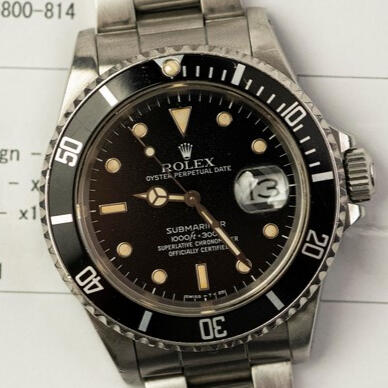
Rolex Submariner with Zubmariner, Zorro or Flat-S Dial — A Subtle Icon.
The term “Zubmariner” refers to a distinctive dial variant found on certain late-1980s Rolex Submariner Date watches, most notably the transitional reference 168000 and early examples of the reference 16610.Its defining feature is subtle but immediately recognisable once noticed. In the word “Submariner”, the letter “S” appears unusually flat at the top and bottom, giving it a sharper and more angular shape than on standard dials. This is why collectors also refer to the variant as the “Zorro dial” or the “Flat-S dial”.These names are not official Rolex terms. They come from the collector community and describe an observable dial-printing trait. The purpose of this site is to document that trait, compare known examples, and provide a sober guide for collectors interested in this small but fascinating detail of Submariner history.

Contents
01 — What is a Zubmariner dial?
02 — Why this dial matters
03 — Historical context
04 — How to identify a Rolex Flat-S / Zorro dial
05 — What a Zubmariner is not
06 — Rolex Submariner 168000 dial variations
07 — Early Rolex Submariner 16610 dial variations
08 — Later “Semi-Zorro” dials
09 — Rarity of the Zubmariner dial
10 — Zubmariner dial value and collectability
11 — Authentication approach
12 — Frequently asked questions
13 — Sources & References
What is a Zubmariner dial?
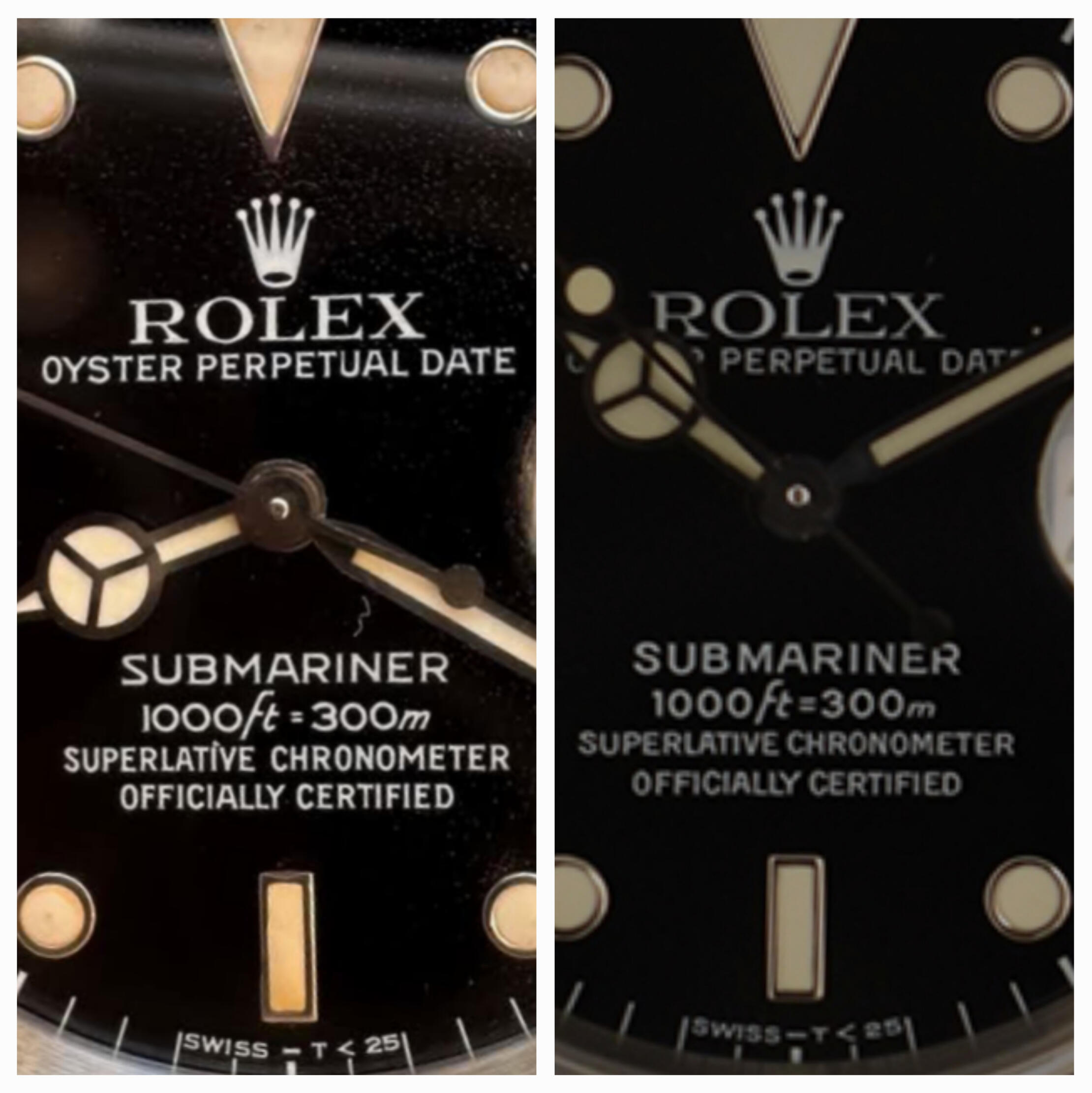
A Zubmariner dial is not a separate Rolex model, nor a special edition. It is a collector name for a particular typographic variation on the dial of some Rolex Submariner Date watches.On a standard Submariner dial, the “S” in “Submariner” has a rounded, flowing shape. On a Zubmariner dial, the upper and lower curves of the “S” are noticeably flatter. Under magnification, the letter can look closer to a stylised reversed “Z” than to a conventional “S”.This detail appears to be part of the original dial printing. It is therefore best understood as a short-lived production-era variation rather than as an alteration, a later service feature or a separate reference.The terminology varies depending on the collector. “Zubmariner” is the most playful nickname, “Zorro” refers to the visual resemblance with a Z-shaped letter, and “Flat-S” is the most descriptive term. For clarity, this site uses all three terms, but they refer to the same central feature when applied to the strong late-1980s variant.
Why this dial matters
The Zubmariner dial matters because it belongs to one of the most interesting periods in the modern history of the Submariner. The late 1980s were a transitional moment: Rolex moved from the reference 16800 to the short-lived 168000, and then to the long-running 16610.This was also a period in which small differences in dial printing, surface finish and luminous material became especially important to collectors. Many details that were once considered insignificant are now used to understand production sequences, identify original components and distinguish untouched examples from watches that have been serviced or modified.The Flat-S detail is not dramatic. It does not transform the watch at first glance. Its appeal lies precisely in its discretion. It is a small production-era trait, hidden in plain sight, which becomes meaningful only when compared with standard period-correct dials.For that reason, the Zubmariner should not be presented as a separate model. It is more accurately described as a rare dial variant found within specific Submariner references.
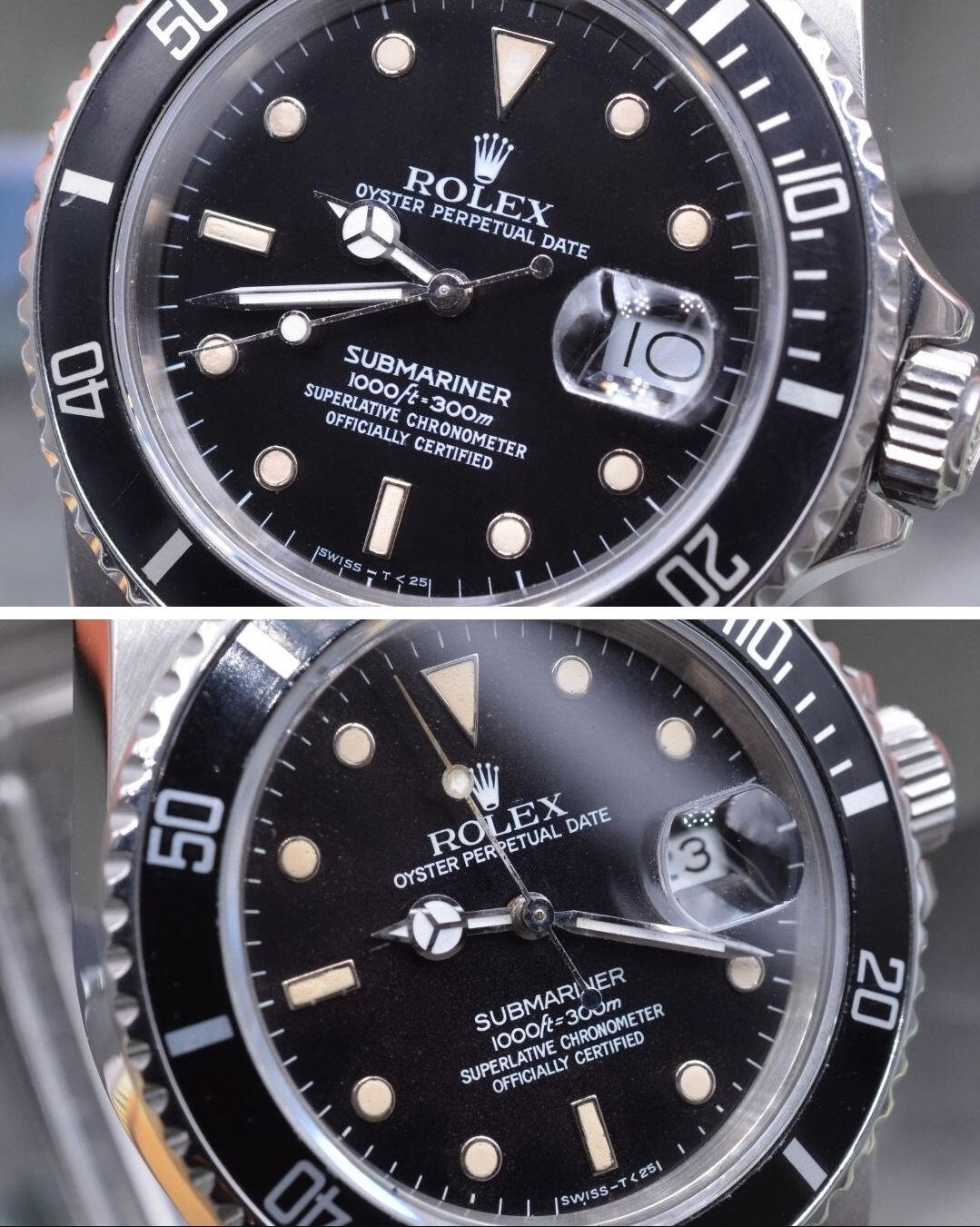
A Rolex Zubmariner 16610 from 1989 (left) compared to a classic 16610 from 1990 (right):
Historical context
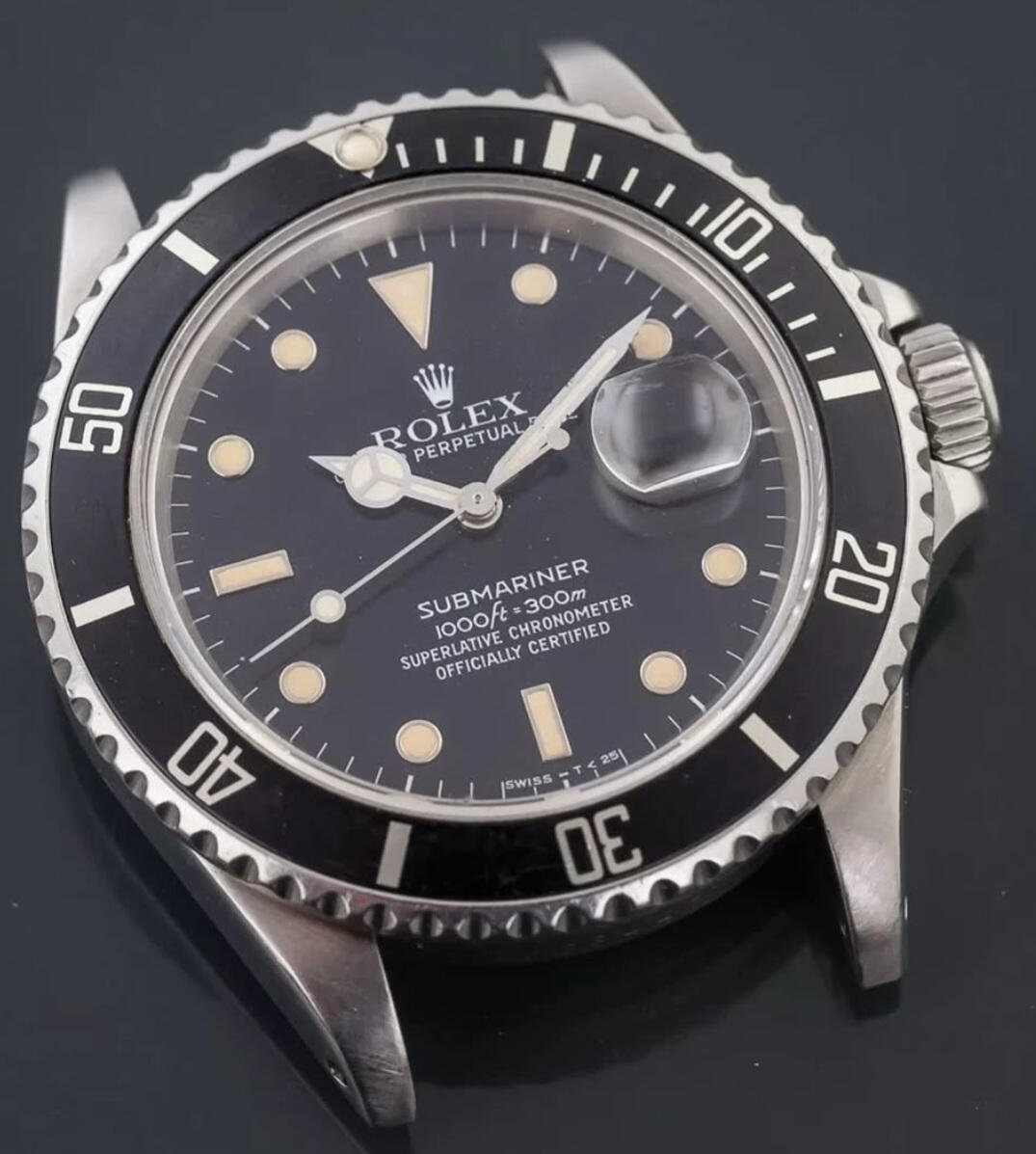
The most convincing context for the Zubmariner dial is the transition from the Submariner Date reference 16800 to the short-lived 168000 and then to the reference 16610.The 168000, often called the “Triple Zero”, occupies a particular place in Submariner history. It was produced for a short period and is generally viewed as a transitional reference. It retained much of the visual identity of the 16800 while introducing changes that anticipated the next generation of Submariner Date.The 16610 then became one of the defining modern Submariner Date references. Introduced at the end of the 1980s, it brought the calibre 3135 and remained in production for more than two decades. Early examples still belong visually and materially to the neo-vintage era, with aluminium bezel inserts, tritium dials and the classic five-digit case profile.The strongest Zubmariner examples appear to cluster around this narrow transition period, especially on the 168000 and on early 16610 watches from roughly late 1988 to early 1991. This supports the view that the Flat-S dial was not a long-running design choice, but rather a short-lived dial-printing variation associated with a limited production window.
How to identify a Rolex Flat-S / Zorro dial
Identification begins with the word “Submariner”. On a convincing Zubmariner dial, the “S” is flat at the top and bottom, giving the letter a sharper profile than usual. The effect is generally clearer under magnification or when the dial is compared directly with a standard Submariner dial from the same period.A true Flat-S dial should not be confused with a blurry photograph, a distorted crystal, damaged printing or an optical illusion. The shape should remain visible in clear macro photographs and should be consistent across different angles and lighting conditions.The “S” is the defining feature, but it should not be examined in isolation. A credible example must also make sense as a whole. The dial should be period-correct, the luminous material should be coherent with a late-1980s tritium Submariner, and the watch should fit the expected reference and serial context. The hands, case, bracelet and service history also matter. A Zubmariner dial is meaningful only when it sits within an otherwise coherent watch.Some late-1980s examples also show other typographic traits, such as distinctive depth-rating text or slightly unusual spacing. These details can support the identification, but they should remain secondary. The Flat-S remains the central criterion.
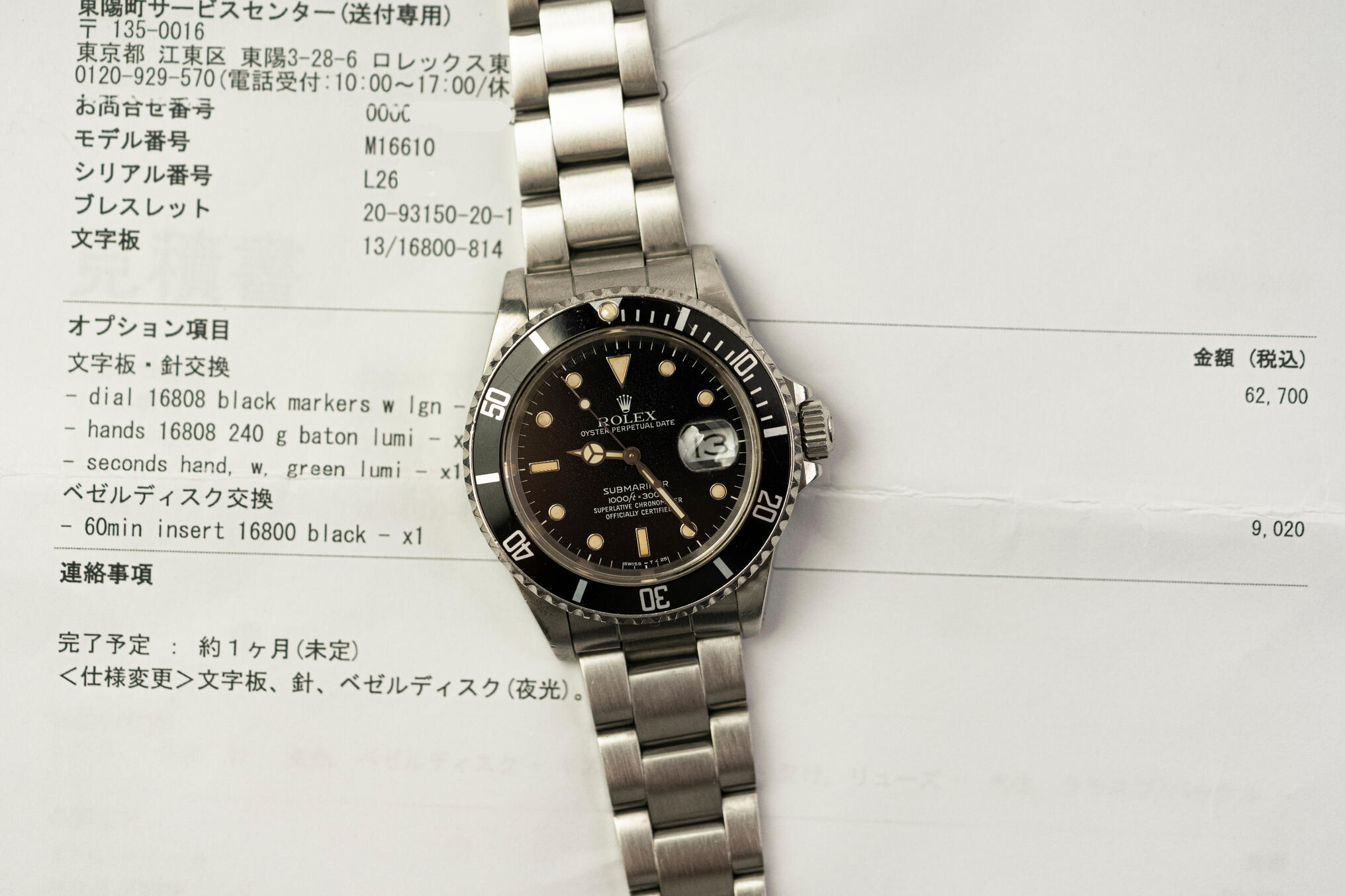
A beautiful 1988/1989 Rolex Submariner 16610 L-series, saved from the Rolex service center in Tokyo, which wanted to replace every part. Had the owner not rejected the estimate, this watch would have lost its soul and its collector’s value :
What a Zubmariner is not
A Zubmariner is not an official Rolex designation and should not be described as such. It is not a separate reference, a limited edition, or proof on its own that the entire watch is original.It is also not a guarantee of value. The presence of a Flat-S dial can add collector interest, but condition, originality, provenance and overall coherence remain essential. A tired or incoherent watch with a Flat-S dial will not necessarily be more desirable than a strong standard example.The most accurate description is therefore simple: the Zubmariner is a rare collector-observed dial variation found on certain late-1980s Submariner Date watches.
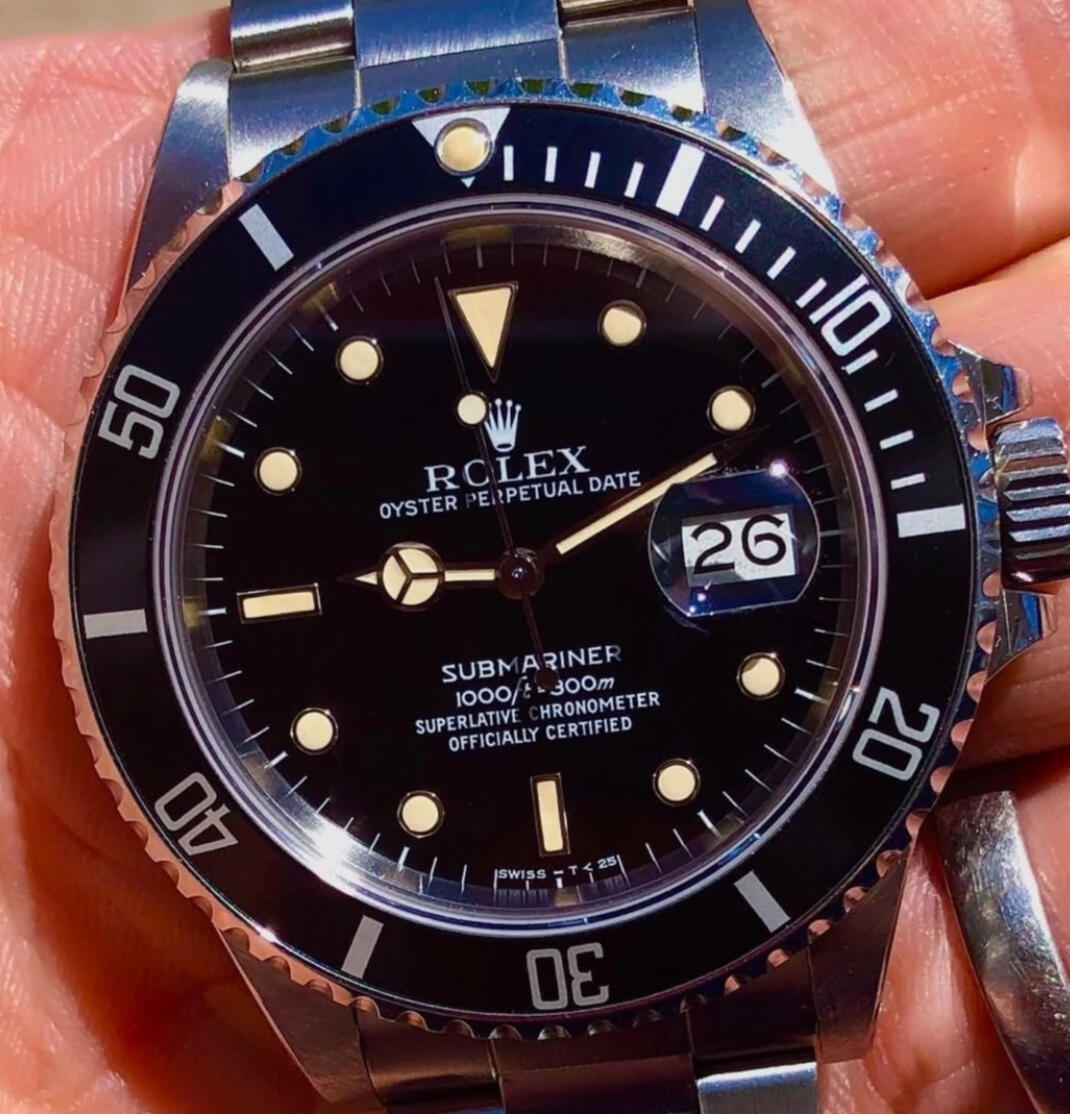
A 1987/1988 Submariner 168000 in mint condition :
Rolex Submariner 168000 dial variations
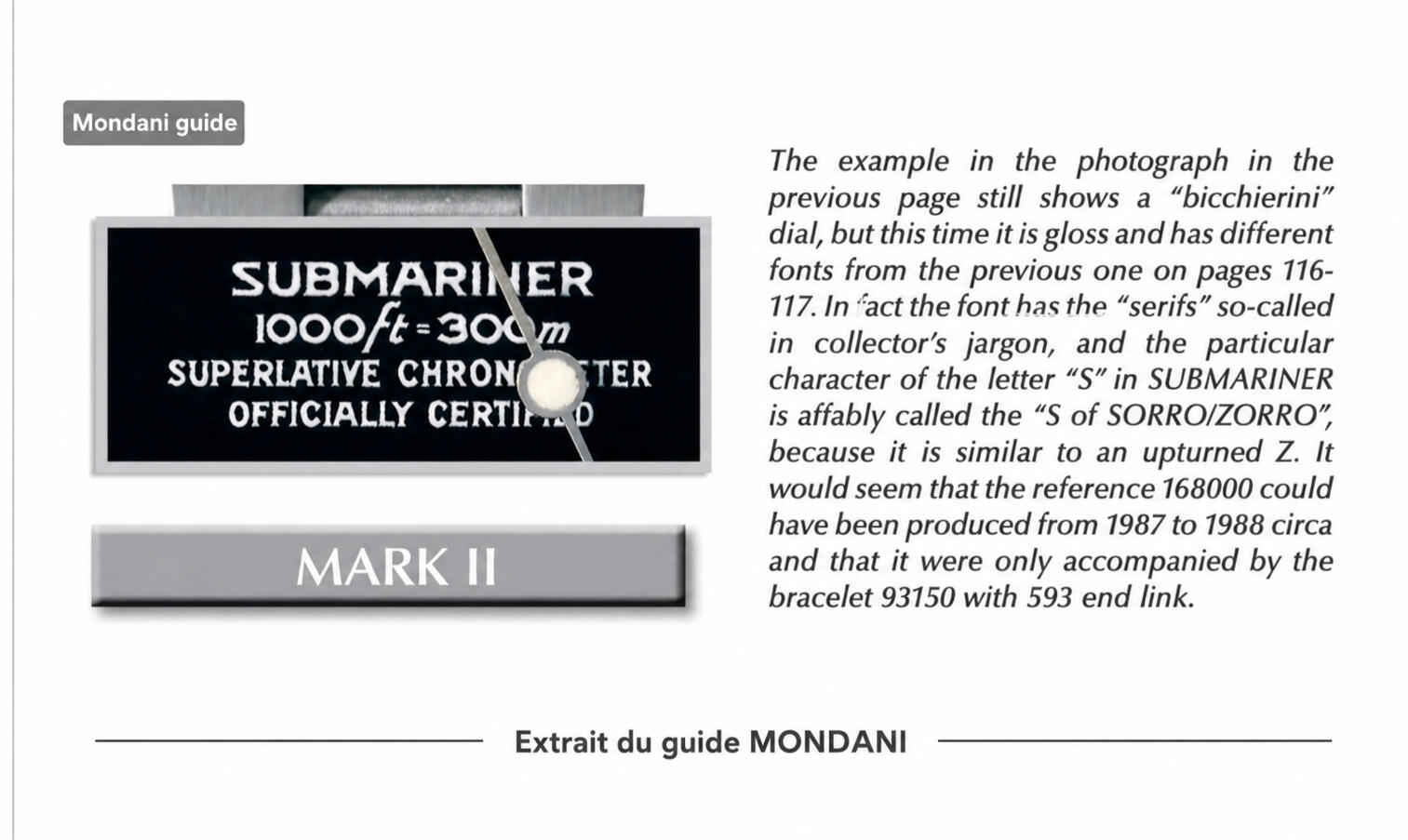
The reference 168000 is central to the Zubmariner discussion. It is short-lived, transitional and already of particular interest to Submariner collectors. It is also one of the references on which the Flat-S dial has been most clearly documented.The Mondani Submariner / Sea-Dweller guide identifies two dial variants for the 168000, including a 168000 Mk I dial corresponding to the Flat-S / Zorro configuration. This is important because the same visual configuration appears on some early 16610 watches.A plausible explanation is that some early 16610 examples received remaining 168000-style dials during the transition between the two references. This should be presented as a strong collector hypothesis rather than a proven factory fact. It is supported by visual comparison, production timing and the narrow period in which the strongest examples appear, but it has not been officially documented by Rolex.This connection is one of the reasons why the Zubmariner dial is interesting. It may represent a small trace of continuity between the short-lived 168000 and the first years of the 16610.
Early Rolex Submariner 16610 dial variations
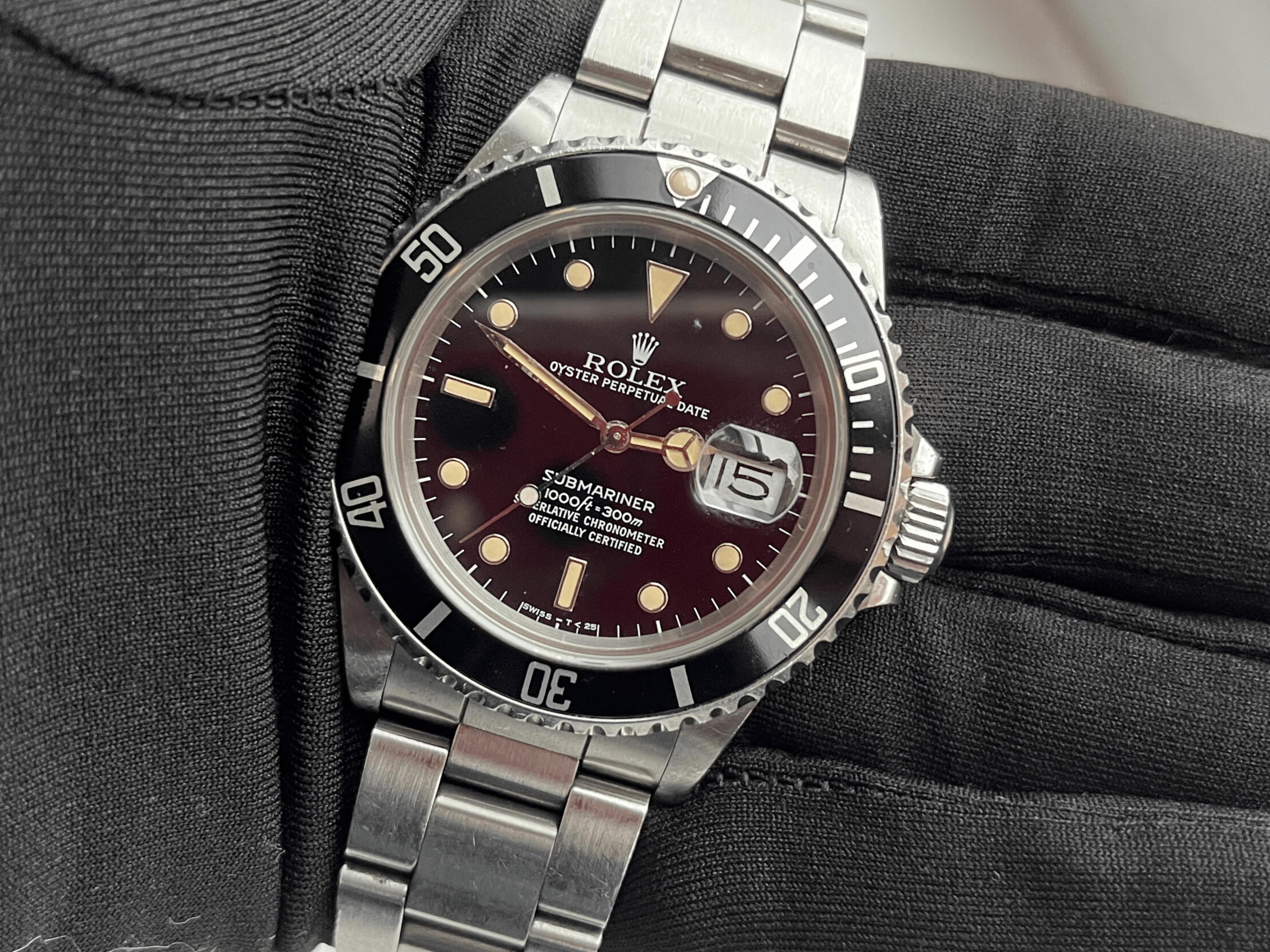
The reference 16610 succeeded the 168000 and became one of the most important Submariner Date references. It is also the reference on which the Zubmariner nickname is especially evocative, because the altered “S” appears directly in the “Submariner” line of a watch that otherwise looks like a classic early 16610.The strongest candidates are generally late-1980s and very early-1990s examples with original tritium dials and hands. For collectors comparing early 16610 tritium dial variations, the pronounced Flat-S or Zorro dial is one of the most distinctive short-lived configurations. These watches combine the calibre 3135, the five-digit Submariner case, an aluminium bezel and a dial-printing trait that appears to belong to the preceding transitional period.Not every early 16610 has this dial. On the contrary, the observed frequency appears low. This is why the variant should be documented carefully and compared with other known examples before being described as a Zubmariner.
Later “Semi-Zorro” dials
Some later Submariner dials, especially from the early 2000s, show a subtler flattened-S appearance. These are sometimes described by collectors as “Semi-Zorro” dials.They are interesting, but they should be treated separately from the stronger late-1980s Zubmariner variant. The visual effect is generally less pronounced, the production context is different, and the dials no longer belong to the same tritium-era transition from the 168000 to the early 16610.In this guide, the term “Zubmariner” is therefore reserved primarily for the strong late-1980s Flat-S dials, while “Semi-Zorro” is used only as a comparative category.

Rarity of the Zubmariner dial
The exact number of Zubmariner dials produced is unknown. Rolex has never published production figures for this variant, and the term itself comes from the collector community. Any estimate must therefore remain cautious.That said, it is possible to build a reasoned order of magnitude. A little over 600,000 Submariner 16610 watches are generally estimated to have been produced between 1988 and 2010, which would imply an average of around 30,000 watches per year. However, this average is probably misleading for the earliest years of the reference. Production was likely lower at the beginning of the 16610’s life than during the peak years of the 2000s.The strongest Zubmariner examples on the 16610 appear to cluster between late 1988 and early 1991. A conservative working assumption is therefore to use around 15,000 watches per year over that period, or approximately 45,000 early 16610 examples. Even if one used 20,000 watches per year instead, the final order of magnitude would remain broadly similar.The next question is how many of those early 16610 watches originally received a Flat-S dial. The most useful comparison is the transitional 168000. On collector forums, manual counts based on public listings have often suggested that roughly 5% to 10% of 168000 examples show a Zubmariner / Zorro dial. A manual count on Chrono24 gave a similar result, with 4 Zubmariner dials identified among 52 listed 168000 examples, or approximately 7.5%.This matters because the Flat-S dial observed on early 16610 watches appears very close, and in some cases identical, to the Mk I dial described for the 168000 in the Mondani guide. If early 16610 Zubmariner dials are indeed remaining 168000-style dials used during the transition, then a comparable frequency is plausible.Manual counts of public listings for 1988–1991 Submariner 16610 examples also point in the same direction. Several searches limited to early 16610 examples, with dial photographs examined individually, generally produced results between 4% and 6% of watches showing a convincing Zubmariner / Zorro / Flat-S dial. In practical terms, this usually means only three to five visible examples among roughly one hundred early 16610 listings, and many of them are not identified as such by the sellers.Applying a 4% to 6% range to an estimated 45,000 early 16610 watches gives approximately 1,800 to 2,700 original 16610 Zubmariner dials.
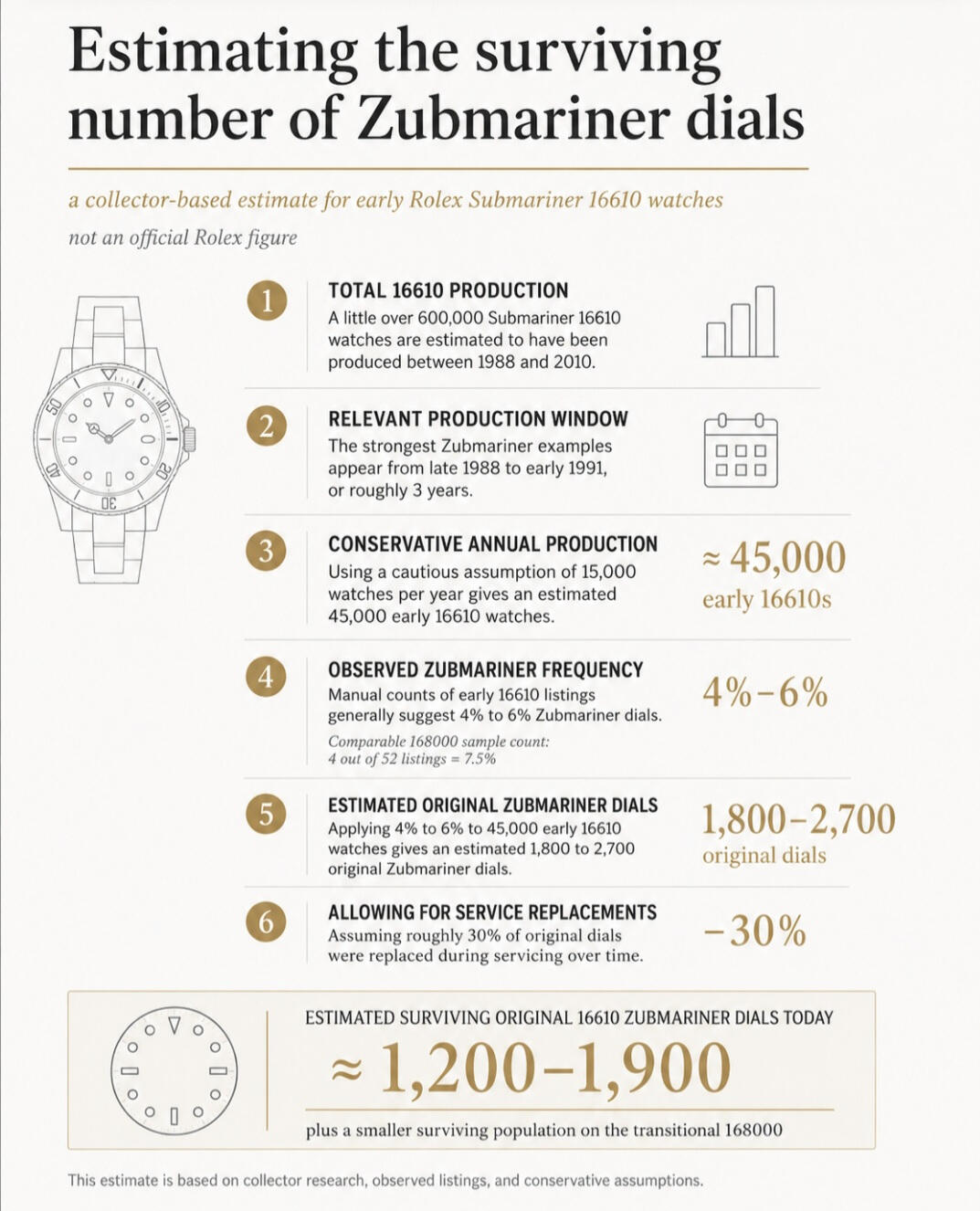
The number of surviving watches with their original Zubmariner dial is likely lower. Many late-1980s tritium dials were replaced during Rolex servicing, especially when showing ageing, lacquer degradation, moisture damage or other visible defects. This is particularly relevant because some Zubmariner dials appear to have suffered from specific ageing issues.Some collectors have suggested very high destruction or replacement rates for 168000 dials. A more conservative assumption is that around 30% of original Zubmariner dials may have been replaced over almost four decades. On that basis, the estimated number of surviving Rolex Submariner 16610 watches retaining their original Zubmariner dial would be approximately 1,200 to 1,900 examples.This range is not a factory figure. It is an informed collector estimate based on observed listings, production assumptions and a conservative allowance for service replacements. A smaller number of 168000 examples should be added to it, probably ranging from a few dozen to perhaps a small few hundred surviving watches.On this basis, the Zubmariner / Zorro / Flat-S dial should be understood as a genuinely rare Submariner dial variant. Its estimated surviving population appears lower than some better-known modern Rolex dial variants, such as the Daytona “APH” dial, often estimated by collectors at several thousand examples. The comparison should be made carefully, because the APH Daytona is more widely known and more liquid, while the Zubmariner remains a niche collector variant. But in terms of estimated surviving numbers, the Zubmariner may be considerably scarcer.The most responsible formulation is therefore the following: the Zubmariner dial is a rare, collector-observed Submariner dial variation, probably surviving in low thousands at most on the 16610, with a smaller additional population on the 168000. This remains an informed estimate, not an official Rolex figure.
Flat-S vs regular S :
Zubmariner dial value and collectability
The Zubmariner dial can add collector interest to an already desirable Submariner reference, but it should not be treated as a stand-alone investment thesis. Its market remains narrow, specialist and dependent on informed buyers.The strongest examples are those in which the dial variant forms part of a coherent watch. A clear Flat-S dial, original tritium hands, a credible serial range, strong case condition and convincing provenance all matter. Box and papers are not strictly necessary, but they can support the overall story of the watch.The variant is also still under-recognised. Many listings do not identify the dial as a Zubmariner, even when the feature is visible. This creates an interesting situation for collectors: the trait is rare enough to matter, but not yet widely enough known to be consistently priced into the market.That said, caution is essential. A dial variant does not override condition, originality or service history. A poorly preserved or heavily serviced watch with a Flat-S dial may be less desirable than a strong standard example. The Zubmariner detail should be seen as an additional layer of collector interest, not as a substitute for the fundamentals.
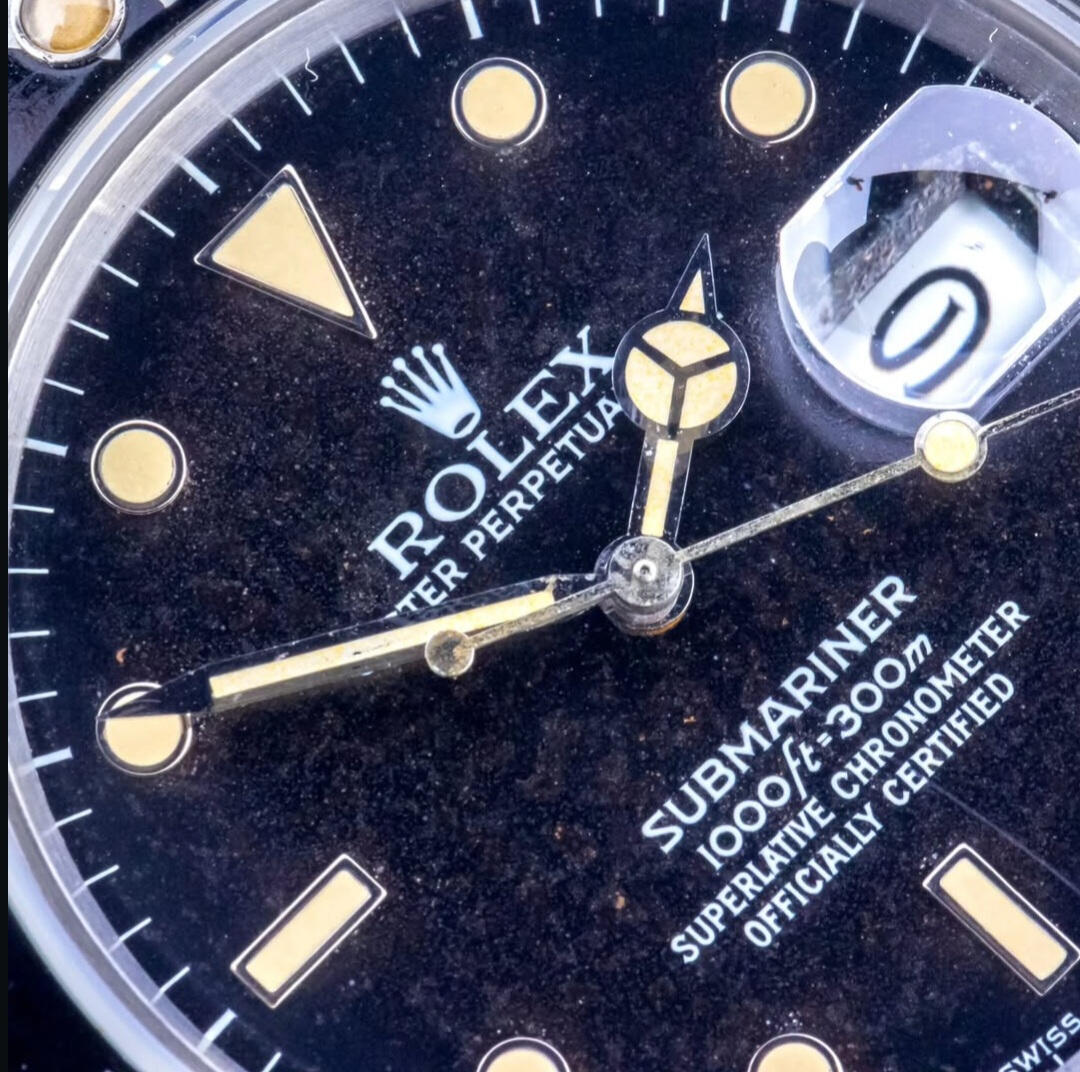
A Submariner that has clearly been affected by water damage, but which nevertheless has a patina that a discerning collector will appreciate :
Authentication approach
Authentication should begin with the dial, but it should never end there. The shape of the “S” must be assessed from sharp macro photographs and compared with known examples. The printing should be crisp, consistent and visually coherent with late-1980s tritium Submariner dials.The reference and serial range must also make sense. A convincing 168000 or early 16610 example should fit the expected production window. The hands should be period-correct and reasonably consistent with the dial plots. The bracelet, end links and insert should be examined as part of the whole watch, even if replacements are not necessarily disqualifying when they are disclosed.Service history is especially important. A later Rolex service dial will generally remove the very feature that makes a Zubmariner interesting. Conversely, an original dial with ageing, patina or lacquer changes may be more collectible than a cosmetically cleaner watch that has lost its original dial.The safest approach is therefore comparative rather than declarative. A watch should be described as a Zubmariner only when the Flat-S is clearly visible, the dial is period-correct, and the rest of the watch is coherent with the claimed reference and production period.
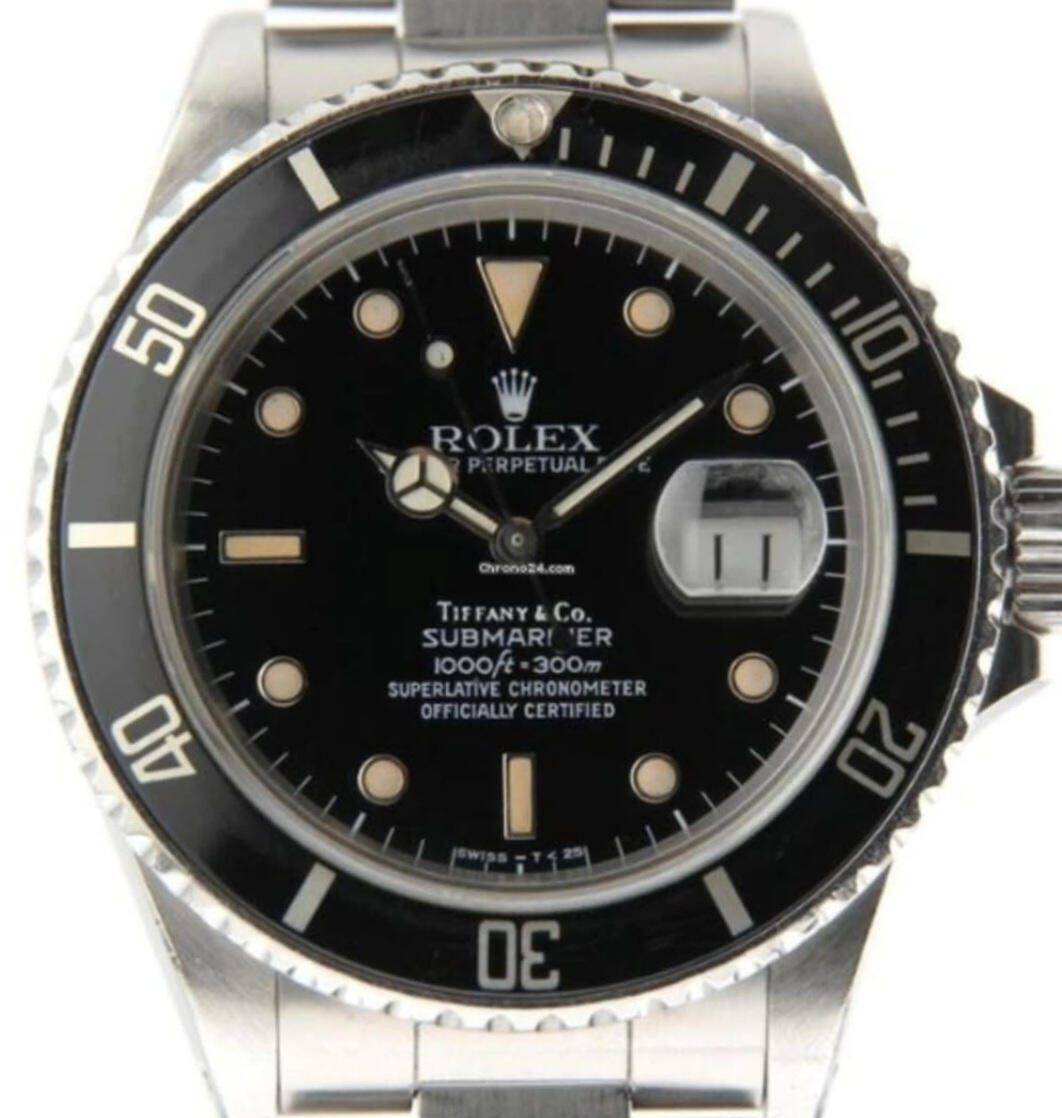
A Submariner 168000 with two unique features: a Tiffany dial and a Zorro dial. Sold for nearly $100,000 in 2025 :
Frequently asked questions
Is “Zubmariner” an official Rolex name?
No. Rolex has not officially used the term. “Zubmariner”, “Zorro” and “Flat-S” are collector nicknames used to describe the distinctive shape of the “S” in “Submariner”.
Is the Zubmariner a separate Rolex model?
No. It is a dial variant found on certain examples of existing Submariner references, mainly the 168000 and early 16610.
Does every 168000 have a Zubmariner dial?
No. The Flat-S trait appears to be present only on a minority of observed examples.
Can a 16610 be a Zubmariner?
Yes. Early 16610 examples from the late 1980s and around 1990 can show the Flat-S dial. The strongest candidates are original tritium examples from the early production period.
Are early-2000s examples the same thing?
Not exactly. Some later dials show a subtler flattened-S appearance, sometimes called “Semi-Zorro”. They are interesting, but they should be distinguished from the stronger late-1980s Zubmariner dials.
Does a Zubmariner dial make the watch more valuable?
It can, but only when the watch is otherwise correct and attractive. Condition, originality, provenance, matching tritium hands and overall coherence remain essential.
Can the dial be faked?
Any collectible dial trait can eventually be copied or misrepresented. Clear macro photographs, comparison with known examples and expert review are strongly recommended before relying on the Flat-S trait alone.
Which Rolex references and production periods can have a Zubmariner dial?
The strongest documented examples appear on the short-lived Rolex Submariner 168000 and on early 16610 watches produced roughly from late 1988 to early 1991. This narrow window matches the transition between the two references and the tritium-dial era. Not every watch from these years has the feature: the dial, serial context, hands and overall configuration must still be assessed together. Later dials with a subtler flattened S are better described separately as Semi-Zorro dials.
How can an original Zubmariner dial be distinguished from a Rolex service dial?
A credible original example should combine the pronounced Flat-S printing with period-correct tritium markings, luminous plots, typography and serial context. The printing should remain clear in macro photographs taken from more than one angle. A later Rolex service dial normally uses a different print configuration and may carry Luminova-era markings, although service history must be checked case by case. Matching hands, case condition, bracelet details and documented provenance help support the conclusion; the shape of the S alone is never sufficient authentication.
How does a Zubmariner dial affect value and collectability?
It can add collector interest and sometimes a premium when the dial is original and the watch is coherent, well preserved and correctly documented. The strongest value case combines a clear Flat-S or Zorro trait with matching tritium hands, an appropriate serial range, a strong case and credible provenance. The rarity of the dial is only one factor: it does not compensate for a replacement dial, poor condition, undisclosed service parts or an inconsistent history. The market remains specialist, so premiums can vary substantially between buyers.
Sources & References :This independent guide is based on collector observation, documented examples and comparative dial analysis. Rolex has not published official documentation naming a “Zubmariner”, “Zorro” or “Flat-S” dial; these terms and the rarity estimates should therefore be understood as collector research rather than factory data.Selected references- Rolex Submariner Sea-Dweller — Mondani Books, including its dial classifications for reference 168000.
- Rolex Submariner Date 16610: All Dial Versions, a collector taxonomy with documented Flat-S examples.
- Rolex 16800/168000 Dial Variation, a Vintage Rolex Forum discussion with comparative examples.
- Rolex Submariner 168000 “Zubmariner” Guide, a collector overview of the transitional reference.
- Rolex Submariner — official overview, for the broader history and technical context of the model.MethodologyThe estimates presented here are derived from manual review of publicly visible listings and photographs, comparison with published dial classifications, and the conservative assumptions stated in the “Rarity” section. They are indicative estimates, not official production figures. Sources and market observations were last reviewed in September 2026.
Zubmariner.com is an independent collector website. It is not affiliated with, authorised by or endorsed by Rolex SA or any related entity.“Rolex”, “Submariner” and other brand names are trademarks of their respective owners and are used here only for identification, research and commentary purposes.Nothing on this website constitutes authentication, appraisal, investment advice or a recommendation to buy or sell any watch. Collectors should consult qualified professionals before purchasing, selling or servicing vintage watches.